Do you feel that your attack lacks bite or that your playing comfort isn't optimal? The choice of your guitar pick is often an overlooked detail that can radically transform your sound and fluidity on the fretboard. Here you'll discover how to select the right thickness and the perfect material to finally find the accessory that fits your fingers.
Summary
ToggleKey points:
The thickness dictates your playing style. To make your chords flow more smoothly, choose a flexible pick (Thin). To gain attack and precision on your solos, switch to a rigid model (Heavy). This is the most economical solution to instantly transform your sound and comfort.
The basic criteria for making the right choice
There's no point beating around the bush. Before even talking about style, two things dictate 90% of your sound: the thickness and material of your pick. Master that, and you'll be well on your way.
Thickness, the first setting for your sound
Thickness (or "gauge") is the most direct factor. A thin model bends under the string, while a thick one remains rigid. This is the fundamental difference that changes everything.
We're talking millimeters here, and a mere tenth of an inch can transform the sound and your attack.
Here is a simple guide to help you navigate the categories:
- Extra-thin (< 0.45 mm) : Pour les rythmiques acoustiques très douces, presque un murmure.
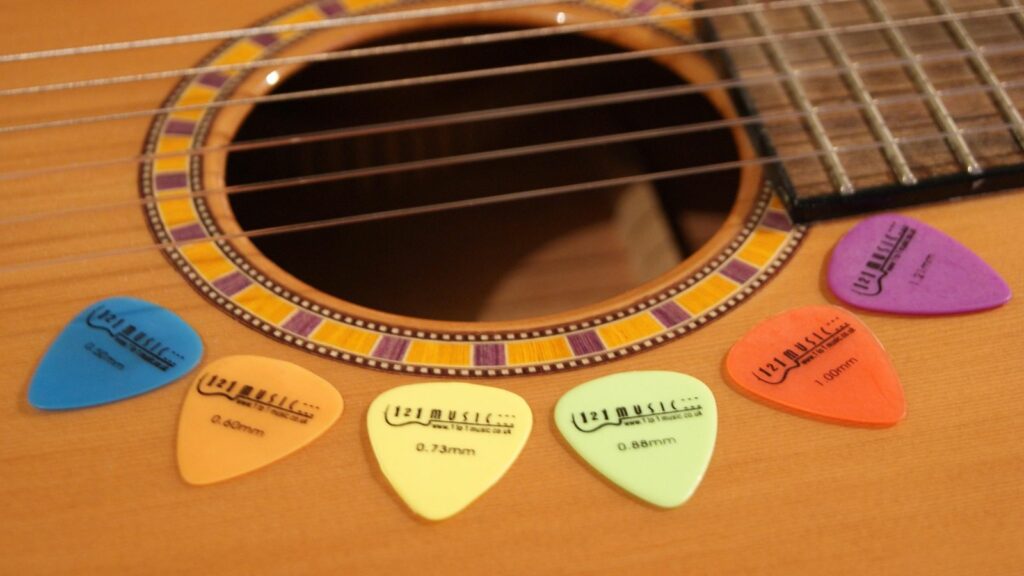
- Thin (0.45 to 0.70 mm): Ideal for beginners and for smooth strumming in folk/pop music.
- Medium (0.70 to 0.85 mm): The Swiss Army knife. Flexible enough for rhythm, rigid enough for solos.
- Heavy/Extra-heavy (> 0.85 mm): For attack and precision. Essential for rock, metal, and jazz.
The material, the secret soul of the pick
The material is what colors the sound. Most picks are made of plastic, but not all plastics are created equal.
Plastic is inexpensive but wears out quickly. It is a consumable.
Here is a memo of common materials and their characteristics to avoid disappointment:
- Celluloid: The quintessential "vintage" sound, warm and round.
- Nylon: Flexible and warm, perfect for soft rhythms.
- Delrin (Tortex): A balanced sound with a slightly grainy attack.
- Ultex: Bright, clear, and extremely durable. A very defined sound.
"Noble" materials: a luxury for a unique sound?
Advanced guitarists, consider wood, stone, or bone. It's not just a matter of aesthetics.
Their impact is real: they bring out the harmonics. Wood is warm, stone is bright and aggressive.
It's a personal quest for sound. It's worth trying once you've mastered the basics with traditional picks.
Shape and size: a question of comfort and precision
Now that the sound is pretty much sorted, let's talk about your fingers. The best pick in the world is useless if you can't hold it properly. Here, we're talking about comfort and control.
The standard shape, the effective all-purpose tool
The "teardrop" shape, or type 351, unsurprisingly dominates the market. It offers the ideal compromise between sufficient surface area for grip and a sharp attack point. For 90% of guitarists, it is the logical starting point.
This versatile geometry handles sweeping rhythms and early solos equally well.
If you're just starting out, don't look any further for now. Master this standard before trying out more exotic formats.
Specific forms: jazz, triangle, and other variations
Other options are available for specific needs. The Jazz III, small and pointed, is a formidable weapon for speed and surgical precision. The triangle offers an enormous gripping surface and three usable points.
You'll also come across unusual tools such as the "sharkfin," designed to offer multiple attack textures in a single tool.
These are not marketing gimmicks, but technical solutions to real gaming problems.
Size: more than a detail, a matter of control
Here, everything is a matter of compromise. A large pick is reassuring because it is easy to hold, but it quickly becomes clumsy as soon as you pick up the tempo.
Conversely, reducing the size boosts finesse and control, which are major advantages for hybrid picking. The downside? It's harder to pinch firmly without it slipping at first.
The only judge is the test drive. Your body type and style will dictate the final choice.
Which pick for which style and which guitar?
Enough theory. Let's get down to business. Here's how to put the pieces of the puzzle together to find the pick that's right for your music.
The correspondence table for clarity
Let's not beat around the bush. Consider this table your ultimate cheat sheet for choosing a guitar pick without getting a headache. I've compiled the standards used by pros. Personal feel is paramount, but this information will save you from wasting time with unsuitable equipment.
| Music Style | Recommended Thickness (mm) | Material / Suggested Form | Guitar Type |
|---|---|---|---|
| Folk / Pop (Rhythmic) | 0.60–0.85 mm | Nylon, Celluloid / Standard | Acoustic guitar |
| Rock (Rhythmic) | 0.73–0.88 mm | Tortex, Delrin / Standard | Electric guitar, Acoustic guitar |
| Rock/Metal (Solo) | 1.0–2.0+ mm | Ultex, Acrylic / Jazz III, Pointed | Electric guitar |
| Jazz | 1.14+ mm | Ultex, Wood, Horn / Jazz, Standard (rounded tip) | Electric guitar (Archtop type) |
| Blues | 0.80–1.14 mm | Celluloid, Tortex / Standard | Electric Guitar, Acoustic Guitar |
Folk rhythms or pop chords: the quest for fluidity
Rock/metal solos and jazz precision: attack above all else
Holding and using your pick (and knowing when to do without it)
Getting started: the basics for a good start
The most effective method is to place the pick on the side of your bent index finger, then hold it in place with your thumb. This position provides natural stability without effort. It's simple and works immediately.
Don't grip too tightly, as this creates unnecessary tension. If you grip too loosely, you will lose the pick. Your grip should be relaxed but firm.
Leave only a small part of the tip protruding. You need just enough material to grip the rope firmly.
Pick wear: when should you replace it?
Yes, guitar picks wear out. A damaged pick sounds bad and becomes difficult to control.
This is a detail that many guitarists mistakenly overlook. Don't make this mistake, because your sound will suffer directly as a result. You may not realize how much a worn pick can ruin your attack. Use this checklist to see if your pick is ready for the trash.
- Rounded tip: you lose all precision and your attack becomes weak.
- Chipped edges: they snag the rope and produce unwanted noise.
- Surface has become slippery: if the pick had a non-slip texture, its absence makes it difficult to grip.
- Loss of rigidity: the pick seems "tired" and no longer responds as it used to.
Playing without a pick? Alternatives to consider
Yes, you can play without a pick. This is called fingerstyle playing, and it produces a much warmer and more nuanced sound. Learning fingerstyle guitar can help you become a truly well-rounded guitarist.
Hybrid picking offers the best of both worlds. It combines the direct attack of the pick with the complex polyphony of the fingers.
Thumb tabs offer an interesting alternative. You retain the attack of a pick while maintaining the freedom of finger playing.
You now have all the information you need to choose the right pick for you. Remember that there is no such thing as the perfect model: it all depends on your style and comfort. The best thing to do is to try out several different picks to find the one that really suits you. So, test them out, listen to your ears, and trust your instincts.
Frequently Asked Questions
What exactly is a guitar pick?
It is a small accessory, usually triangular in shape, that you hold between your thumb and index finger to pinch or strum the strings of your guitar. It acts as an extension of your fingers to give you a clearer attack and a more powerful sound.
Beyond volume, it offers greater precision, especially for fast solos, and protects your fingernails during intense rhythms. It's the basic tool for sculpting your sound.
Does the mediator have any other names?
Yes, you will often hear the term"plectrum," which is the more technical or traditional name. If you talk to English-speaking musicians or look at imported equipment, they will refer to it as a "pick."
The word "tab" is also sometimes used, although this term more specifically refers to picks that slip directly onto the thumb or fingers for fingerpicking.
How much does a guitar pick cost?
It's the most economical accessory for guitarists! For standard plastic models (nylon, Tortex, etc.), the price ranges from a few cents to one euro per unit. So it's very affordable to try out several different ones.
If you opt for "noble" or artisanal materials such as wood, horn, or stone, the price can rise to several euros per piece. But to start with, the classic versions are more than enough.
What thickness should you choose for your guitar?
It all depends on your playing style. If you play a lot of strumming chords on an acoustic guitar, go for a thin or medium pick. Its flexibility will make strumming the strings smooth and enjoyable.
On the other hand, for solos, rock, or metal, you need precision. In that case, opt for a thick (heavy) pick. Since it doesn't bend when it comes into contact with the string, it gives you total control and immediate attack.
Can you play without a pick?
Absolutely! Playing directly with your fingertips or fingernails is called "fingerstyle." This technique produces a much warmer, rounder sound and allows you to add more nuance to your playing.
It's simply a matter of preference and the sound you're looking for. There's nothing stopping you from using a pick for your rock songs and switching to your fingers for your acoustic ballads.