

Vibrato on the electric guitar is a bit like the cherry on top of expressive playing. Some use it to add subtlety, others to trigger completely crazy effects. When mastered, it can add depth to a solo (likeharmonicsortapping) or bring a dramatic touch to a chord. However, if not used correctly, it can quickly turn into chaos and leave the guitar completely out of tune. In this article, we'll look at how to use the famous whammy bar without messing things up.
Summary
ToggleWhat exactly is vibrato?
Vibrato is the art of slightly oscillating the pitch of a note to give it more life and expressiveness. On an electric guitar, it can be produced in two ways: either with the fingers by slightly moving the string on the neck, or with the vibrato bar (or whammy bar), which directly modifies the tension of the strings by acting on the bridge.
In fact, we often hear the term "tremolo" used to refer to vibrato, particularly on certain guitar models such as the Fender Stratocaster with its "tremolo system." This is a mistake, because tremolo refers to a variation in volume, whereas vibrato affects the pitch of the notes.
The advantage of a mechanical vibrato is that it allows youto go further than finger vibrato: you can lower or raise the pitch of notes more dramatically, create impressive diving effects, or add texture to chords. But to useit properly, you need to know the different systems and how they work.
The different types of vibrato on an electric guitar
Not all electric guitars have the same vibrato system. Depending on the model and style of music, some bridges offer more or less flexibility, stability, and range of effects. Here are the main types you may encounter.
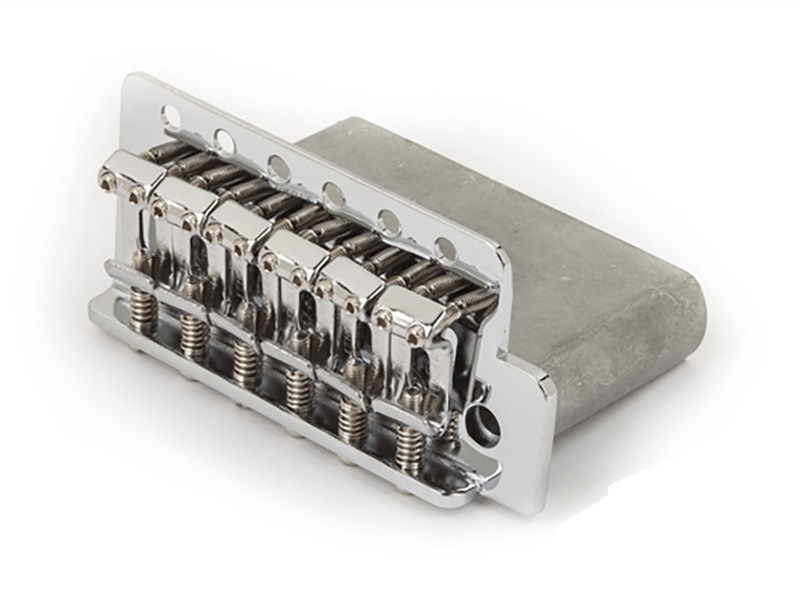
Stratocaster-style vibrato (synchronized with six screws or floating)
This is undoubtedly the best known, popularized by Fender on the Stratocaster. This system allows for subtle effects such as slight undulations or moderate drops. It is fairly stable as long as the strings are properly installed, but excessive use can quickly throw the guitar out of tune. It is perfect for blues, rock, or pop.
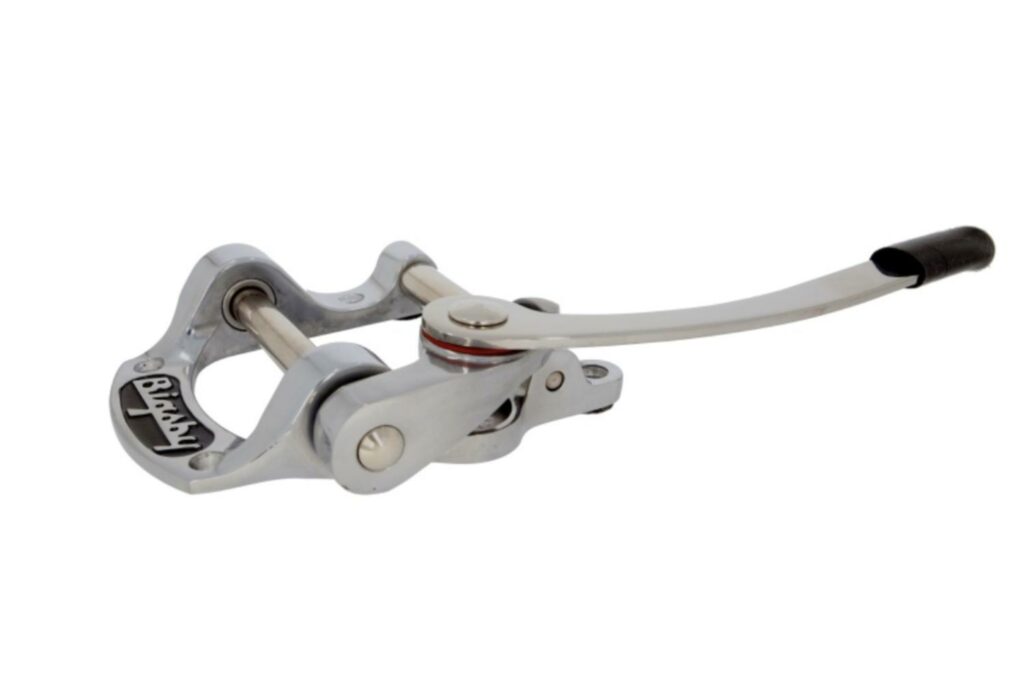
The Bigsby: retro and smooth
Recognizable by its rounded shape, the Bigsby is often mounted on hollow-body or semi-hollow guitars. It offers a very smooth vibrato, perfect for subtle effects in jazz, rockabilly, or blues. Its main drawback? It doesn't have a wide range and isn't the most stable in terms of tuning.
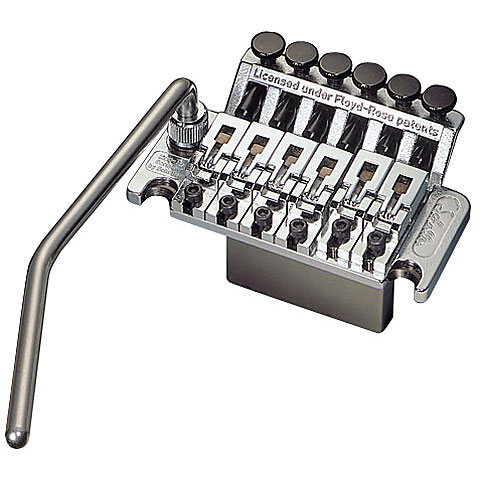
The Floyd Rose: the vibrato monster
The Floyd Rose system is designed for guitarists who want to take vibrato effects to the extreme. It allows for extreme dive bombs, aggressive note bends, and totally crazy playing without too much risk of going out of tune. It works with a string locking system that stabilizes the tuning, even after heavy use. Very popular in metal and shredding. The downside? It is more complex to adjust and maintain.
How to use the whammy bar correctly?
Basic techniques: essential movements
- Light tremolo (shimmering vibrato): By gently pressing the bar, you can add a subtle effect to chords and sustained notes. This is ideal for creating an ethereal sound reminiscent of David Gilmour.
- Moderate pitch bend (dipping): By lowering the bar slightly after playing a note, you create a slight drop in pitch. Useful for an expressive effect without too much exaggeration.
- Slight pitch bend: If your vibrato allows it (such as a well-adjusted Floyd Rose), you can also pull the bar to raise the pitch of the notes.
More pronounced effects: when vibrato becomes a show in itself
- The dive bomb: A classic rock and metal technique. Play a note and slam the bar down to lower the sound by several octaves. This creates a dive-bomb effect, popularized by Eddie Van Halen.
- Flutter: A quick effect where you let the bar bounce slightly after releasing it, creating a metallic oscillation. Typical of guitarists such as Steve Vai.
- Floating harmonics: By combining vibrato with natural or artificial harmonics, you can achieve strange and futuristic sounds, often used in shred and prog.
How can you prevent your guitar from going out of tune?
- Lubricate the nut: A drop of graphite (grease pencil) on the friction points of the nut helps the strings slide better.
- Uses self-locking mechanics: These stabilize the tuning by minimizing string movement.
- Check the tension of the springs: A poorly adjusted vibrato (too loose or too tight) can throw your guitar off balance. Adjust the springs for a more reliable return to the neutral position.
- Don't use unnecessary force: The harder you pull on the whammy bar, the more likely you are to have tuning problems. The important thing is balance and control.
FAQs about guitar vibrato
Can you add a vibrato to a guitar that doesn't have one?
Yes, but it's not always easy. Some systems, such as Bigsby or Stetsbar, can be installed without too many modifications. However, adding a Floyd Rose or floating vibrato to a fixed guitar often requires digging into the body, which is a delicate operation.
What is the difference between a floating vibrato and a fixed vibrato?
A floating vibrato (such as the Floyd Rose or certain well-adjusted Stratocaster vibratos) allows the bar to move both up and down, giving the effects greater amplitude.
A fixed (or "decked") vibrato, often locked by springs, only allows pitch drops and offers greater tuning stability.
Why does my vibrato return poorly to the neutral position?
If the note does not return perfectly to its original pitch after using the bar, this may be due to several issues:
- Nut that jams the strings (lubricate it with graphite).
- Worn or poorly balanced springs.
- Poorly adjusted bridge, especially on a Floyd Rose.
How do you adjust the tension of the springs on a vibrato?
You can adjust the tension of the springs located at the back of the guitar by screwing or unscrewing the mounting plate:
- Screw in the springs: makes the vibrato more rigid and limits movement.
- Loosen the springs: allows for more flexibility, but may make tuning less stable.
The goal is to find a good balance between flexibility and stability.
Can you use a vibrato on an acoustic guitar?
It is very rare, but there are systems such as Bigsby that can be installed on certain electro-acoustic guitars. However, vibrato is less effective on an acoustic guitar because it depends on the tension of the strings and the resonance of the guitar body.




I naturally like your website, but you need to take a look at the spelling in several of your posts. A number of them are rife with spelling problems, and I find it very bothersome to tell the truth. On the other hand, I will surely come back again.
Thanks for your feedback! The site was originally written in French, and the errors you noticed are due to a plugin that automatically translates the pages into the reader’s local language. So the mistakes are unintentional and simply caused by automatic translation errors. 🙂
I just like the helpful information you provide in your articles.
Awesome! It's a genuinely remarkable post. I have gained a much clearer understanding from this post.
Truly exceptional writing. I'm a new fan.
This is pure inspiration, beautifully articulated in a blog post! Finishing it left me feeling invigorated and ready to embrace new challenges. I absolutely love the positive and empowering message.
I really like your blog... very nice colors & theme. Did you design this website yourself or did you hire someone to
do it for you? Please reply as I'm looking to design my own blog and would
like to find out where you got this from. Cheers
Hey, thanks a lot! I made it myself. Feel free to message me at contact@gozic.fr if you’d like more information, I’ll be happy to help! Have a great day 🙂