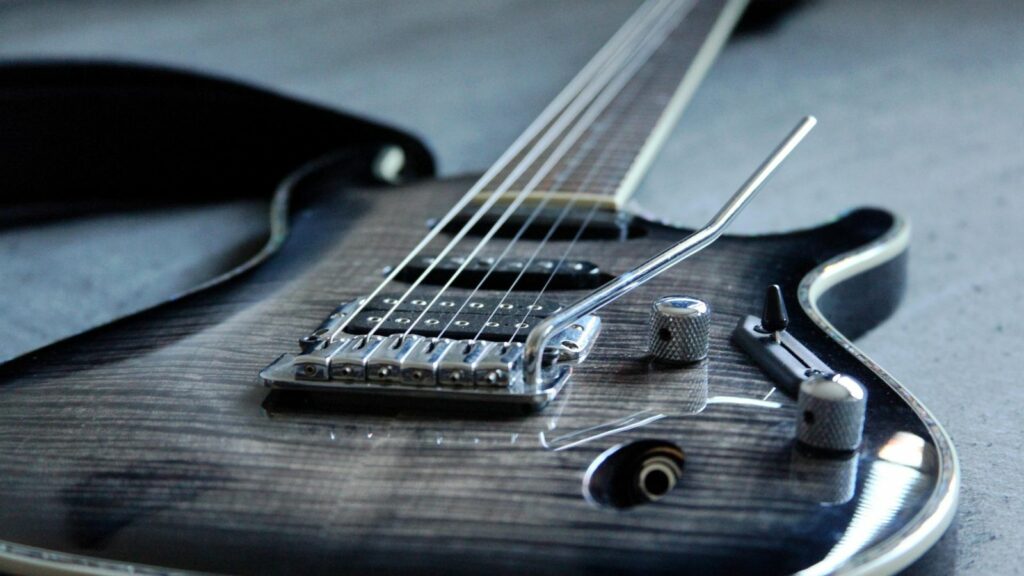

You've probably heard those clear, crystalline sounds produced by a guitar, as if suspended in the air, without really knowing how to create them. These particular sounds are called harmonics. Whether you're a beginner or an experienced guitarist, learning to play harmonics can enrich your playing and add a unique touch to your style. In this guide, we'll explore the different techniques for playing harmonics: from natural to artificial, to the most advanced.
Summary
ToggleWhat is a harmonic on the guitar?
Harmonics on the guitar are pure, airy sounds that stand out for their clarity and lightness. Unlike traditional notes, where you press the string against the fret, harmonics are produced by gently touching the string at specific points. This creates almost "magical" sounds that resonate differently, brighter, and are often perceived as more "floating."
Harmonics are divided into several categories: natural harmonics, which are the most accessible and ideal for beginners, and artificial harmonics, which require a little more technique. As you progress in yourguitar learning, you will also discover tapping harmonics, which are intended for more experienced guitarists.
In this cover video of the song What’s Up by 4 Non Blondes, you can hear some natural and artificial harmonics (at the 21st second of the video, for example).
Why play harmonics? Incorporating harmonics into your playing allows you to explore new sound textures, enrich your compositions, and add a touch of creativity to your style. They are often used to add dynamics to a piece, and they allow you to break away from traditional playing by giving a new color to the sounds your guitar produces.
Natural harmonics: the first step in learning
Natural harmonics are an excellent starting point for discovering the world of harmonics on the guitar. They are produced by lightly touching the string at specific points, called "nodes," where the vibration of the string is modified to create a unique, pure sound. Unlike regular notes, where pressure is applied to the string, here you simply place your finger above the fret without pressing down, then remove your finger immediately after plucking the string. This light touch produces a bright, almost "floating" sound that is often heard in solos and atmospheric passages.
Natural harmonics can be played on certain specific frets:
- The 5th fret,
- The 7th fret,
- The 12th fret.
These frets correspond to the natural resonance points of the string.
How to play a natural harmonic?
To play a natural harmonic, gently place your finger above the metal bar of the fret (not between the frets as you would for a regular note), strum the string, then immediately release your finger. This has to be done in a millisecond; you almost have to remove your finger at the same time as you strum the string. The sound you get should be crystal clear and resonant.
Sur une tablature de guitare, les harmoniques naturelles sont indiquées par un chiffre entre chevrons, comme <12>, pour indiquer une harmonique naturelle à jouer sur la 12ᵉ frette. Si le sujet de la lecture des tablatures t’intéresse, je t’invite à jeter un œil à notre guide dédié !
Artificial harmonics: more advanced techniques
Unlike natural harmonics, where your left hand simply places a finger on the nodes (such as frets 5, 7, or 12) while your right hand strums, artificial harmonics are a little more complex. Here, your left hand finger is busy fretting a specific note, which means your right hand has to do both tasks: touch the string at the harmonic point and strum it simultaneously.
The position of your right finger depends on the fret chosen with your left hand. For example, if your left hand is fretted on the first fret, all the harmonic points will be shifted one fret to the right, so you will need to touch the string at frets 6, 8, and 13.
The two most common techniques for playing artificial harmonics are as follows:
- Pick Harmonics: For this technique, you use the edge of your thumb and the pick at the same time to strum the string. After fretting a note, place the edge of your thumb at a point on the string that generates a harmonic (usually 12 frets above your note), then strum the string with the pick while briefly touching it with your thumb.
- Finger harmonics: Here, your right-hand index finger lightly touches the string at a harmonic point while you strum it with your thumb or middle finger.
Sur une tablature, les harmoniques artificielles se notent différemment des naturelles : tu verras une note classique, comme « 2 », pour indiquer la frette où poser ton doigt gauche, suivie d’une note entre chevrons, comme « <14> », indiquant la frette où ta main droite doit toucher la corde pour produire l’harmonique. L’affichage ressemblera donc à « 2<14> ».
Taping harmonics: the ultimate level
This technique involves producing harmonics by "tapping" directly on the string with a finger of the right hand. Unlike natural and artificial harmonics, here the right hand makes a sharp movement to strike the string at a harmonic point, creating a clear and intense resonance.
To perform a tapping harmonic, start by fretting a note with your left hand. Then, identify a harmonic point, often 12 frets above your fretted note, and strike the string directly on that fret with a finger of your right hand. For example, if your left hand is on the 3rd fret, tap the 15th fret with a finger of your right hand to create the harmonic. The tap should be very quick and sharp; your fingers should not remain in contact with the string for long. It's a bit like touching something hot.
A few pieces using harmonics...
If you want to practice, here is a short list of some great classics that feature harmonics:
- Nothing Else Matters, Metallica (in the intro)
- Roundabout, Yes (in the intro)
- The Rain Song, Led Zeppelin (right after the intro)
FAQs about harmonics on the guitar
Can you play harmonics on all guitars?
Yes! Harmonics can be played on any type of guitar: acoustic, electric, or classical. However, electric guitars with distortion or effects amplify harmonics and often make them easier to hear.
Does the choice of strings influence the sound of harmonics?
Absolutely. Lighter, newer strings tend to produce clearer, more resonant harmonics. Worn or thick strings can make harmonics more difficult to play and less distinct.
Do harmonics depend on the tuning of the guitar?
Yes, tuning affects the position of the harmonic nodes on the string. If you change the tuning (to open tuning, for example), the harmonic points also shift, so it may be useful to locate them again in an alternative tuning.